Catamaran or Monohull? Which Boat Best Fits Your Sailing Vacation?
The discussion among sailors is almost as old as the modern cruising catamaran: Is a catamaran the better boat – or does a real sailing week require a monohull?
Catamaran or Monohull?
There is no universal answer. A sporty, ambitious sailor has different priorities than a family with two children. An experienced crew judges a ship differently than guests spending a week at sea for the first time. And those who want to sail as much as possible may be looking for something different than a group focused on swimming, spending time together, visiting island towns, and life on board.
The crucial question is therefore not: Which type of boat is fundamentally better?
It is: Which ship better suits the people on board and the type of vacation you want to experience?
Two Boat Concepts, Two Different Characters
A classic sailing yacht has one hull and gains a large part of its stability from its ballast keel. Under sail, it heels – meaning it leans to one side. For many sailors, this exact movement is part of the experience. The ship reacts directly to wind, waves, and sail trim, conveying a very direct feeling for the forces acting on a yacht.
A catamaran distributes its living space across two hulls and the bridge deck area in between. Its great width ensures high initial stability. A modern cruising catamaran therefore sails largely upright in normal conditions.
This does not just create more space. The entire life on board feels different.
The Sailing Experience: Where the Monohull Has Special Strengths
Those looking for the classic sailing feeling will often feel more comfortable on a monohull. Heeling, rudder pressure, and the movements of the ship provide immediate feedback. For many experienced sailors, this is precisely the appeal.
I also regularly head out for a few days on a monohull and enjoy feeling the heel, experiencing the boat directly beneath me, and simply sailing in the classic way again.
Well-designed monohulls also generally have advantages when sailing close-hauled. A cruising catamaran often prefers slightly more open courses. How pronounced these differences are depends heavily on design, weight, sail area, loading, and actual conditions.
Another advantage of the monohull is its narrower width. This makes it easier to find a berth and can significantly reduce harbor costs. In tight marinas, a monohull requires considerably less space.
For a small, experienced crew that prioritizes active sailing and can get by with significantly less living space, a monohull may therefore be the more suitable choice.
Sailing Upright: A Big Difference for Vacation Guests
A catamaran heels considerably less than a monohull under typical conditions. For guests without sailing experience, this is often one of the most noticeable differences.
On a heeling yacht, every walk below deck becomes more deliberate. Doors, drawers, dishes, and loose items must be carefully secured. Cooking, showering, or walking to the cabin can also become significantly more challenging while sailing.
On a cruising catamaran, floors, seating areas, and work surfaces remain largely horizontal. This makes daily life on board easier – especially for children, older guests, and people who are initially unsure of their footing on a ship.
This does not mean that a catamaran moves through the water without motion. It rolls less, but can react faster and sometimes more abruptly in short, steep waves. The pitching of the two hulls or impacts under the bridge deck can also be uncomfortable.
"No heeling" is therefore not synonymous with "no movement."
Does a Catamaran Automatically Mean Less Seasickness?
No. That statement would be too broad.
Many guests find the lower heel and reduced rolling of a catamaran more pleasant. Others react specifically to its sometimes shorter and more irregular movements. Seasickness also depends on personal predisposition, wind, wave direction, course, location on board, and numerous other factors.
A catamaran can be more pleasant for some people, but it offers no guarantee against seasickness. One should remain realistic when planning a vacation and not assume that seasickness is impossible on a catamaran.
Space and Quality of Life: The Great Strength of the Catamaran
When comparing two ships of similar length, a cruising catamaran usually offers considerably more usable area. The difference arises from its width and the additional lounging areas between the hulls.
The salon is often on the same level as the cockpit. In addition, there are large outdoor areas, a foredeck, and – depending on the model – a flybridge. Several people can spend time in different places simultaneously without being completely separated from each other.
This is crucial, especially during an entire vacation week. A group does not just spend the sailing hours together. They have breakfast on board, swim, cook, read, talk, occasionally seek peace, and potentially spend a day of bad weather on the ship.
On a monohull, life takes place more along the longitudinal axis of the ship: the cockpit, companionway, and salon form the central areas. This can be cozy and very communicative. However, for a larger group, it can feel cramped more quickly.
The catamaran offers more opportunities to combine community and privacy.
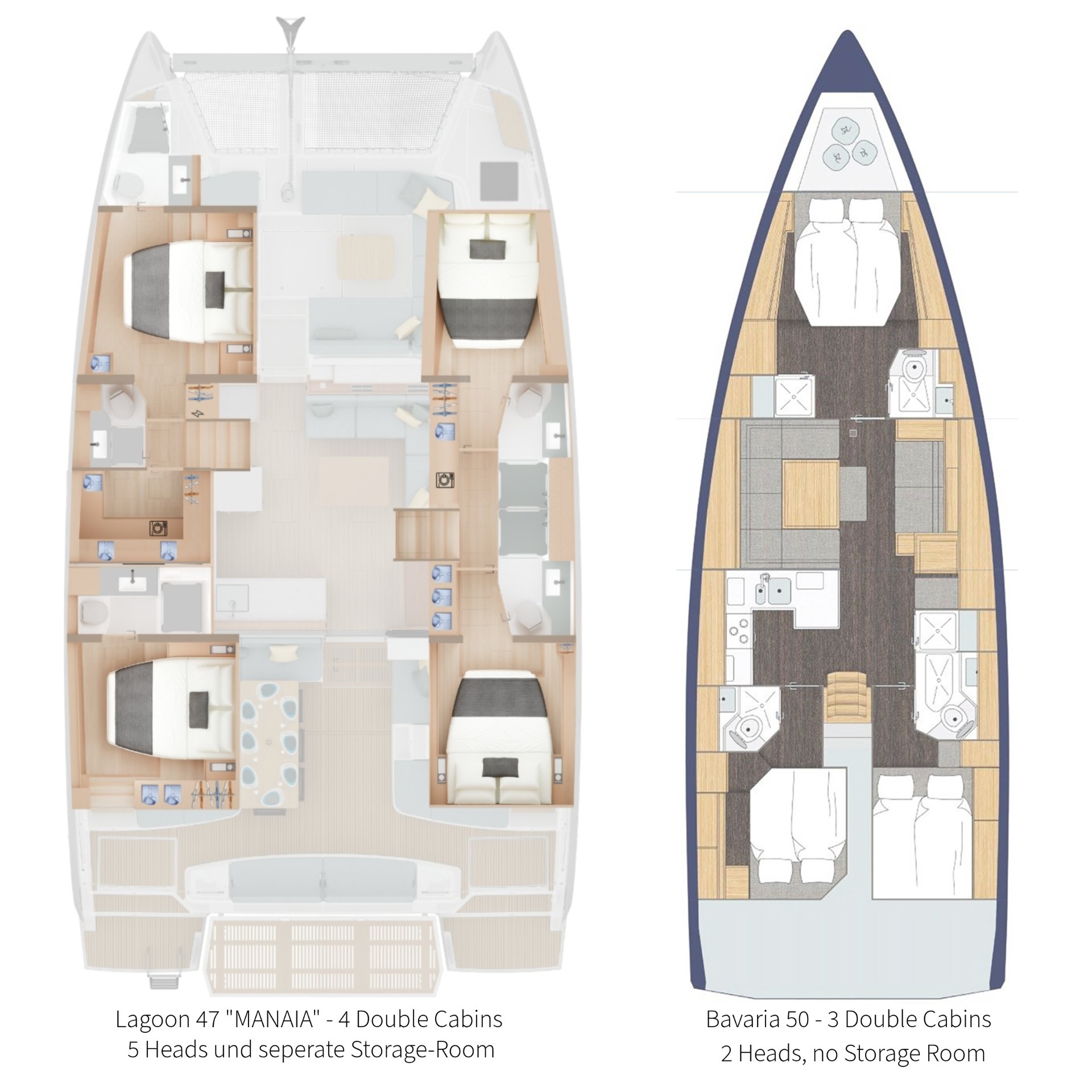
The following image illustrates the differences in layout between our Lagoon 47 and the Bavaria 50, a monohull sailing yacht of exactly the same length.
Privacy for Couples, Families, and Groups of Friends
The two hulls of a catamaran create a natural spatial separation. Cabins are not all directly next to each other, and the group can spread out better through several lounge areas.
This does not make a catamaran a floating hotel. Sounds also carry on board, and areas are shared. Anyone expecting absolute privacy will not find it on any vacation boat.
Nevertheless, the layout is often more pleasant for several couples or a family. Private cabins and bathrooms as well as separate lounge areas reduce the feeling of constantly sitting together in a confined space for a week.
A smaller crew consciously seeking compact life on board, on the other hand, may find the proximity of a monohull particularly social.
Life in the Bay and Access to the Water
Sailing vacations do not only consist of traveling from one place to another. A large part of the week takes place in bays, at anchor, or on a buoy.
Here, the catamaran shows further strengths. Due to its width, it often sits calmly and offers generous areas for sitting, eating, and relaxing. Swim platforms facilitate access to the water, and the relatively shallow draft expands the selection of suitable areas.
The geometry of both concepts already shows how clear the design difference can be: a cruising catamaran is significantly wider than a monohull of comparable length and usually has a shallower draft. The exact values depend on the respective model and its equipment.
The great width is particularly noticeable in marinas: a catamaran requires more berthing space than a monohull of comparable length. Therefore, many marinas charge higher berthing fees for catamarans. The exact pricing depends on the harbor, the season, and the dimensions of the ship.
Maneuvering and Daily Harbor Life
A monohull requires little lateral space but is usually powered by a single engine. Wind and the design of the hull influence the maneuver.
Cruising catamarans generally have two separate engines. This allows them to be turned and moved very specifically. At the same time, their wide and, above all, high structure offers a large surface for the wind. In a narrow or crowded marina, their width remains a challenge.
A blanket statement that one of the two boat types is generally easier to maneuver would not be professional. Design, conditions, and the skipper's experience are decisive.
For guests of a guided sailing week, this question is less central anyway: they primarily choose the form of vacation, while the responsibility for ship handling lies with the skipper.
Safety: No Meaningful Competition with Simple Slogans
Blanket statements do not work for safety either.
Ballast keel yachts are designed to develop a righting moment after heavy heeling, provided the ship and keel remain structurally intact. A modern cruising catamaran, on the other hand, has high initial stability but cannot normally right itself without external help after a complete capsize. Whether and how long a capsized catamaran remains buoyant depends on its construction and possible damage.
These different stability concepts cannot be reduced to the claim that one boat type is fundamentally safe and the other unsafe. Construction, maintenance, loading, weather assessment, and responsible ship handling are equally decisive.
For vacation guests, the choice should therefore not be sold via spectacular extreme scenarios. What matters is that the ship, area, crew, and responsible skipper are suitable for the planned use.
Price is Also Part of an Honest Assessment
Monohulls are usually cheaper to charter for a comparable length. They require less berthing space and typically have only one engine. Those traveling with a small crew and needing little space will often find the monohull to be the more economical solution.
A catamaran costs more, and not just because of the larger space. Two engines, a wider marina berth, and the overall larger usable area affect charter and operating costs.
For several couples or a family, however, one should not just look at the total price of the ship. It is important to consider what space, what cabins, how many bathrooms, and what lounge options the group receives for it. Only a comparison of the actually usable vacation offering provides a meaningful picture.
We explain how the various cost items are composed in detail in the post What does a sailing week in Croatia really cost?
Which Boat Fits Whom?
A Monohull is a Particularly Good Fit if …
the classic sailing feeling and active sailing are central,
heeling is perceived as part of the experience,
a small, agile crew is traveling,
good close-hauled performance is important,
compact harbor berths and lower charter costs are a priority,
less living and private space is required.
A Catamaran is a Particularly Good Fit if …
vacation, shared experiences, and life on board are the focus,
several couples, a family, or a mixed group are traveling,
not all guests have sailing experience,
low heel and simple movement sequences on board are important,
generous community and private areas are desired,
swimming, bays, and longer stays at anchor make up a large part of the week.
This assignment is not a hard line. An experienced sailor can appreciate the peace and space of a catamaran. Conversely, a sporty couple may deliberately choose a monohull because they are looking for its direct movements and classic sailing feel.
Why SAILING MANAIA Relies on a Catamaran
SAILING MANAIA does not offer regatta weeks or sailing training as a core product. The focus is on personally guided sailing vacations for couples, families, and groups of friends – including many guests without their own sailing experience.
The ship is not just a means of transport during this week. It is accommodation, shared living space, a swim platform, and a starting point for experiences on land and on the water.
For this concept, space, low heel, different lounge areas, private guest bathrooms, and easy access to the water are particularly important. That is why we deliberately chose a modern cruising catamaran.
MANAIA, our Lagoon 47, has four double cabins for guests, each with its own bathroom. In addition, there are several lounge areas, a front cockpit, the flybridge, and large outdoor spaces. This layout suits a week where people travel together but do not want to sit in the same place every minute.
This is not a statement against the monohull. For sporty sailing, small crews, or people seeking the traditional feeling of a monohull, it can be the better choice.
For the type of vacation we want to offer, however, the catamaran is the more suitable tool.
Conclusion: Not the Better Boat – But the More Suitable One
Catamarans and monohulls fulfill different expectations. The monohull offers the more classic and often more immediate sailing experience, requires less space in the harbor, and is often more economical. The catamaran offers more living space, less heeling, and a layout that suits families, multiple couples, and mixed groups particularly well.
Anyone basing their decision solely on speed, tradition, or square footage is missing the point.
The better question is:
How do you actually want to spend your week at sea?
If you have an honest answer to that, it usually becomes clear which type of boat suits you better. If a catamaran fits your way of traveling, you can find out about private charter on the MANAIA and cabin charter for couples and solo travelers.